

- Services

Getting to know us
- Industries
Recent case study:
Oracle EBS Cloud Deployment
Consolidating and Migrating assets into Oracle Cloud Infrastructure.
.png?width=250&name=stonewater-logo%20(1).png)
Most Visited Pages
-
- Resources
DSP-Explorer acquires leading Oracle Applications Managed Services Provider, Claremont, to further extend its data management capabilities.

Resources
- Contact us
Real-World AI in Action: Building Intelligent Applications with Oracle AI Services and APEX
Contents
In an era where artificial intelligence is transforming every facet of business operations, the question for many organisations is no longer whether to adopt AI, but how to integrate it meaningfully into existing workflows. Oracle Cloud Infrastructure (OCI) offers a suite of powerful AI services, including generative AI agents, document understanding, computer vision, and natural language processing, that can be embedded directly into enterprise applications.
To demonstrate what's possible, I built a demo application using Oracle APEX that brings together nine real-world AI use cases, each addressing a genuine business need. The application leverages OCI's AI services alongside Oracle APEX's rapid application development capabilities to show how organisations can deliver intelligent, user-facing features without building AI models from scratch.
What follows is a walkthrough of each feature, the business problem it addresses, and the Oracle AI services that power it.
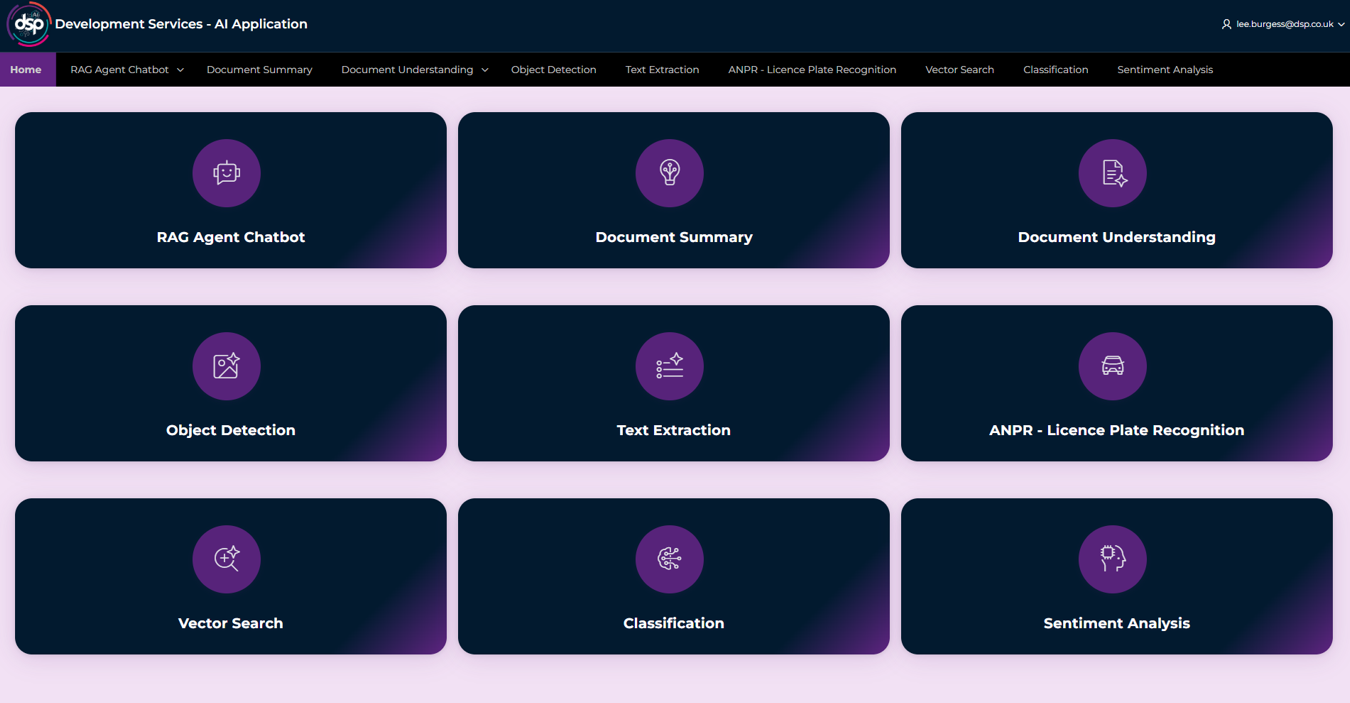
1. RAG Agent Chatbot - HR Policy Assistant
The Problem:
Employees frequently need answers to HR-related questions, such as leave entitlements, company policies, benefits, and onboarding procedures, but finding the right information often means trawling through lengthy policy documents or waiting for a response from the HR team.
The Solution:
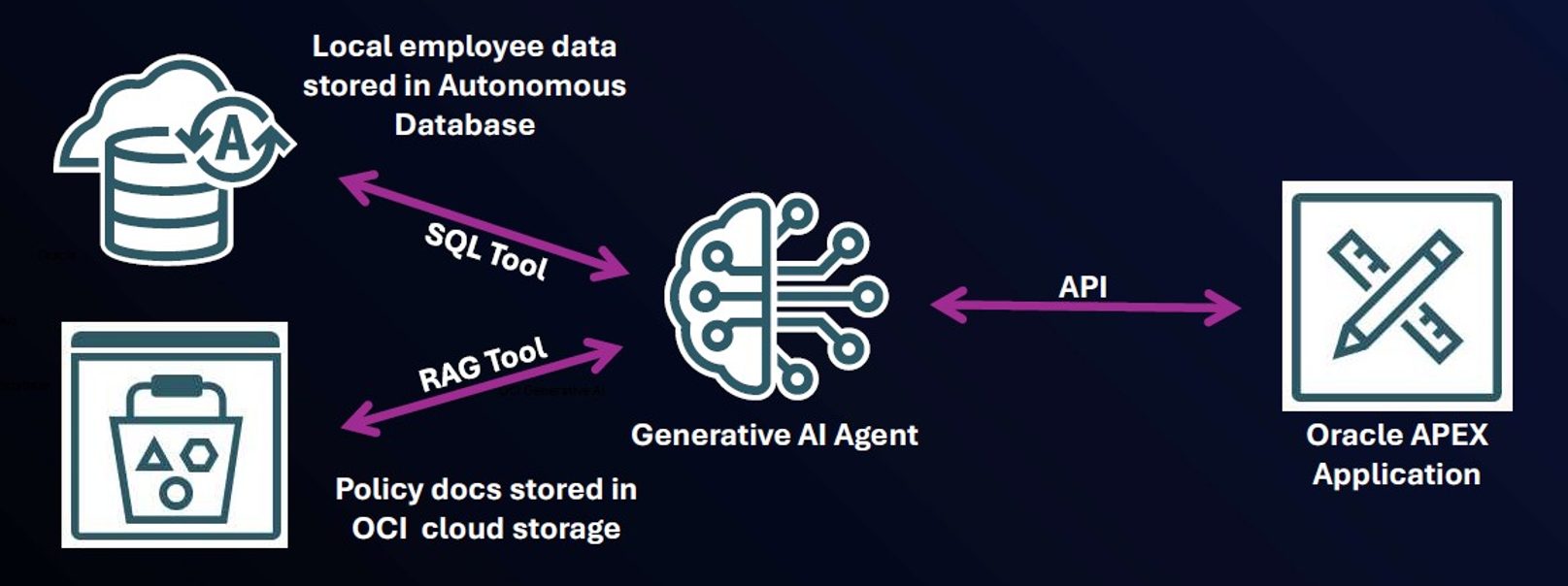
Our chatbot combines structured local data (employee records, leave balances) with unstructured data (HR policy documents) to provide contextual, real-time, natural language responses to user queries. Employees can ask questions in plain English and receive accurate answers drawn from both their personal data and company-wide policies (stored in OCI object storage and maintained in APEX). The chatbot maintains conversational context, allowing users to ask follow-up questions naturally without repeating themselves.
There is also a security layer that prevents users from getting information about other employees.
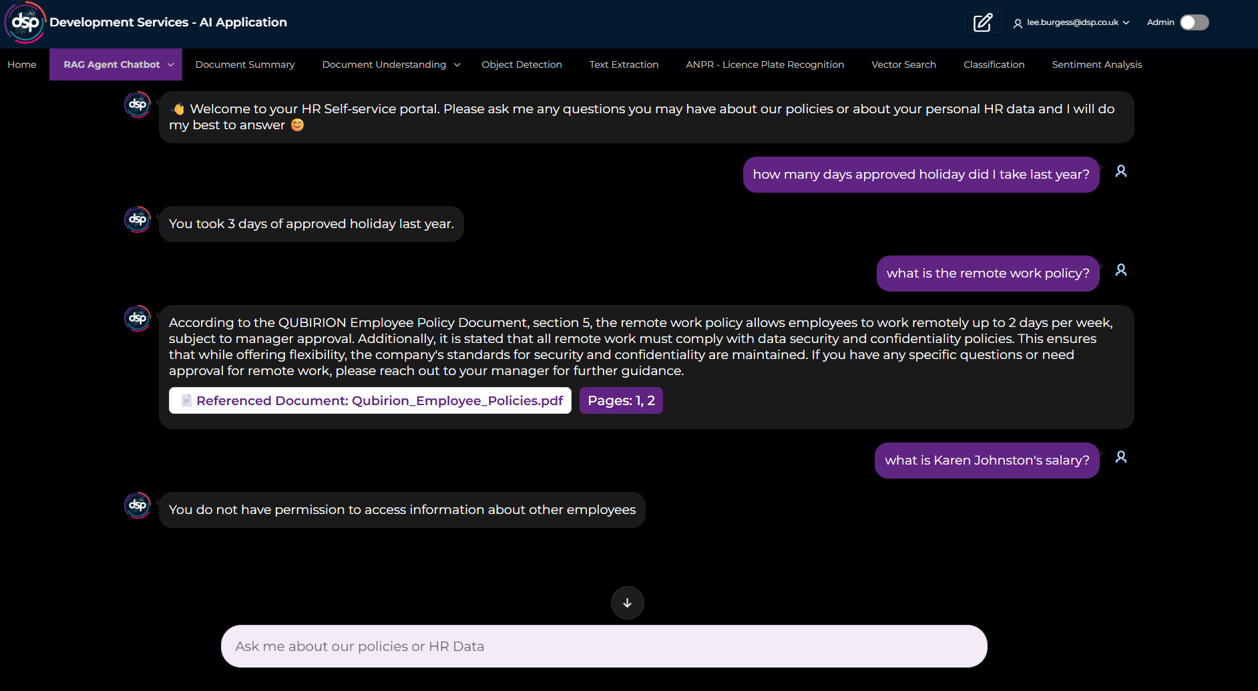
This utilises the power of Oracle's Generative AI Agent service to combine multiple data sources and deliver intelligent responses through a conversational interface built in APEX. The agent handles the complexity of determining which data source to query, applying row-level security so employees can only access their own records, and presenting results in a human-readable format.
For a full overview of this solution, see my previous blog post: Supercharging Oracle APEX with RAG: Building an Intelligent HR Self-Service Portal.
2. Document Summary
The Problem:
Professionals across every industry are inundated with lengthy PDF documents (reports, proposals, contracts, research papers) and rarely have the time to read each one cover to cover. Quickly grasping the key points of a document is essential for informed decision-making.
The Solution:
Upload a PDF document, and a concise summary is automatically generated. Users can review and edit the summary to suit their needs or simply copy it to the clipboard for use in emails, reports, or briefings.
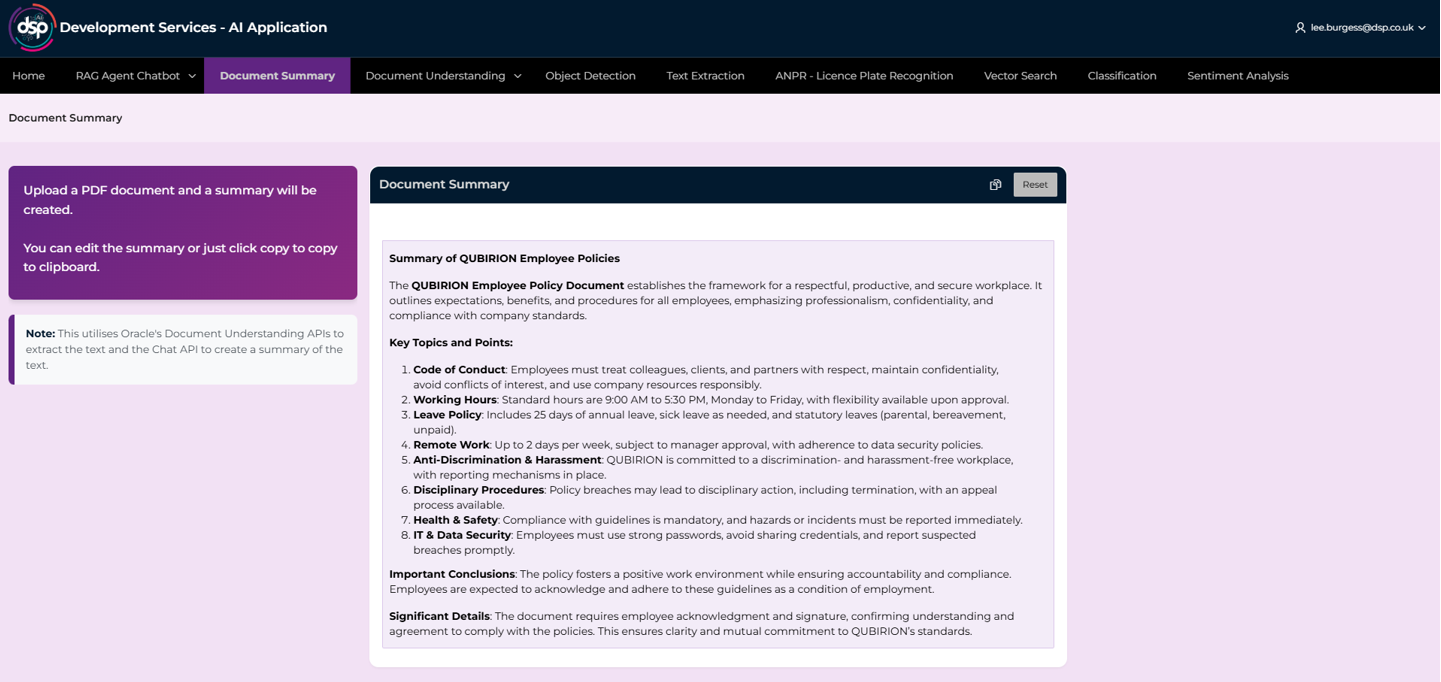
This utilises Oracle's Document Understanding APIs to extract the text content from the uploaded PDF, followed by Oracle's Chat API to analyse the extracted text and produce a coherent, readable summary. The entire process, from upload to summary, takes seconds.
3. Document Understanding - Invoice Processing
The Problem:
The tedious task of processing and extracting key information from a mountain of documents is one of the most time-consuming activities in finance, procurement, and administration. Manual data entry from invoices is slow, error-prone, and costly at scale.
The Solution:
Using OCI Document Understanding and Oracle APEX, you can automate these tasks with prebuilt AI services and customise document extraction to fit your industry-specific needs. Our demo focuses on invoice processing, automatically extracting supplier names, invoice dates, line items, totals, VAT amounts, and more from uploaded invoice documents. I utilised APEX workflows to mimic a real-world process where a user would claim an invoice, make any amendments, and submit for processing.
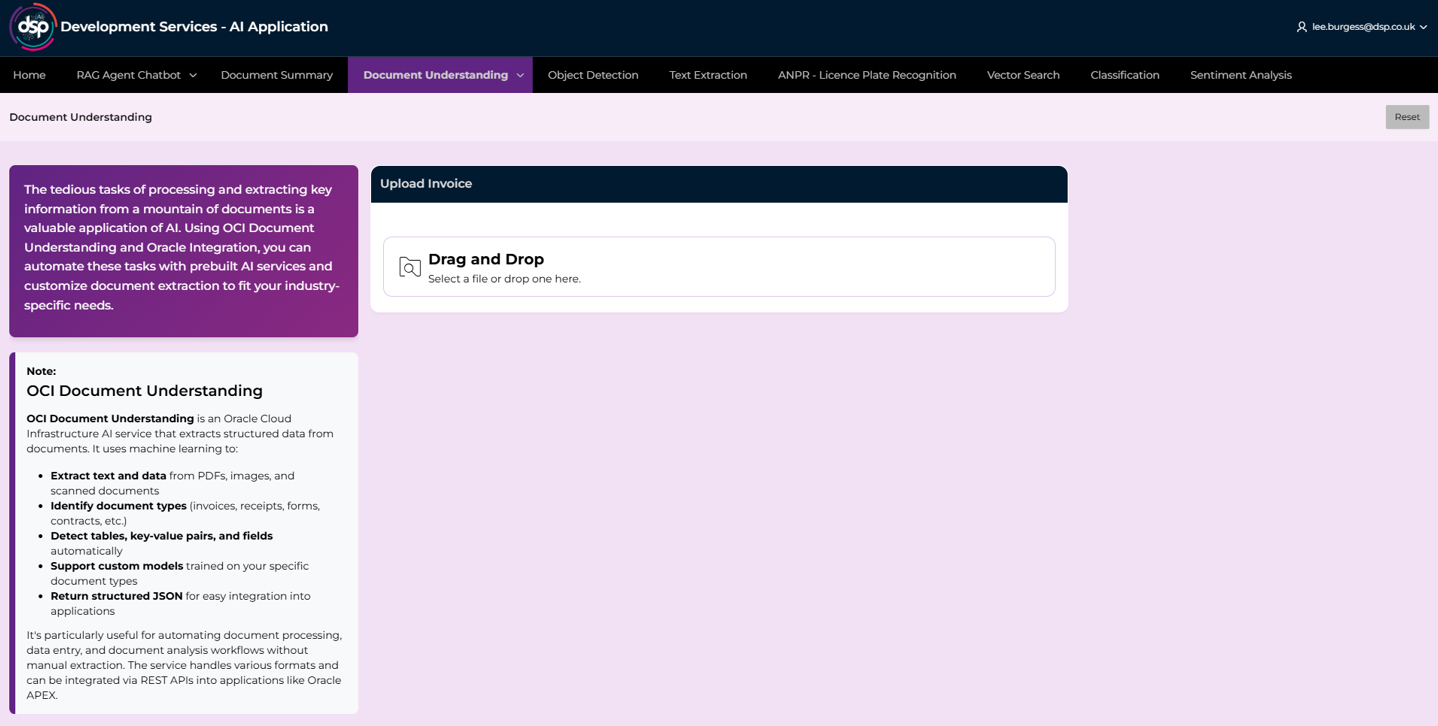
Bespoke warnings and validations can be added to ensure data integrity:
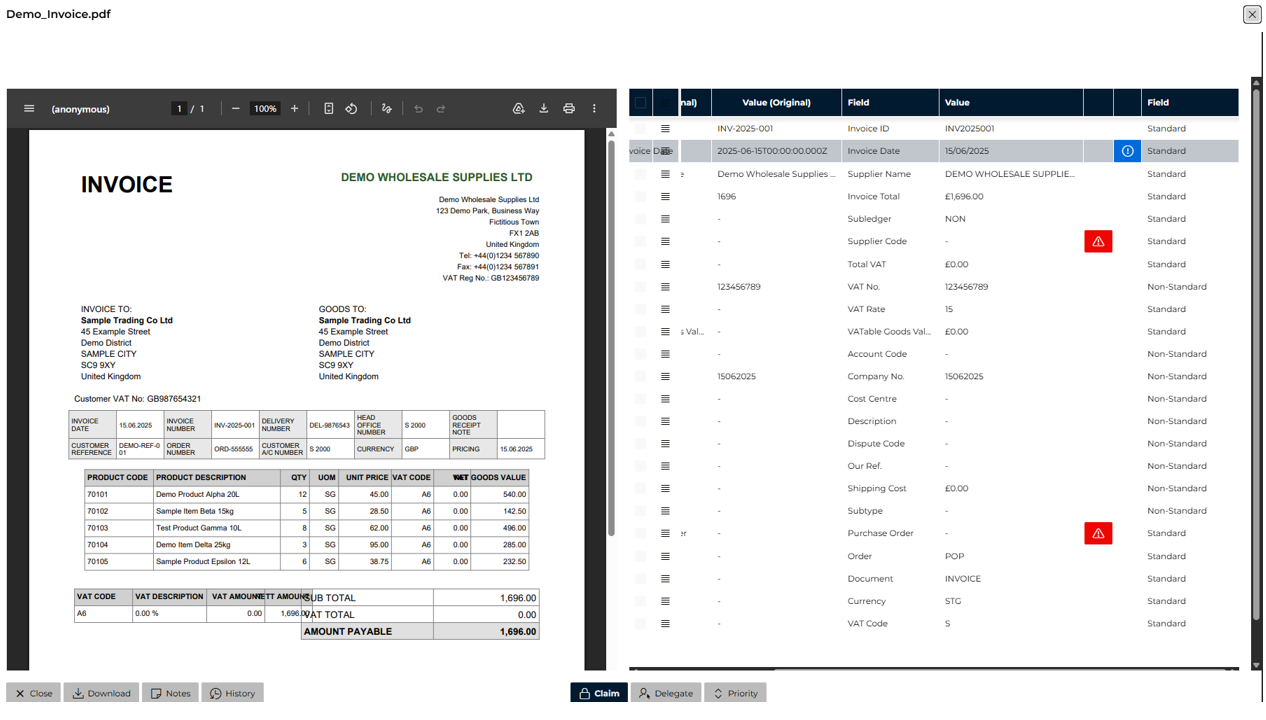
Confidence scores for each field (and overall invoice) are returned. If no validation errors and confidence is over an agreed threshold, then the invoice can be processed automatically.

OCI Document Understanding is an AI service that extracts structured data from documents using machine learning. It can:
-
Extract text and data from PDFs, images, and scanned documents.
-
Identify document types such as invoices, receipts, forms, and contracts.
-
Detect tables, key-value pairs, and fields automatically.
-
Support custom models trained on your specific document types.
-
Return structured JSON for straightforward integration into applications.
It handles various formats and can be integrated via REST APIs directly into Oracle APEX, making it particularly effective for automating document processing, data entry, and document analysis workflows without manual extraction.
4. Object Detection
The Problem:
From quality control on production lines to inventory management in warehouses, the ability to automatically identify and classify objects within images has broad applications across industries. Manual inspection is slow and inconsistent, and organisations need scalable, automated solutions.
The Solution:
Upload images to detect and classify objects within them. The application analyses the image and returns a list of identified objects along with their classifications and confidence scores, providing a foundation for automated visual inspection workflows.
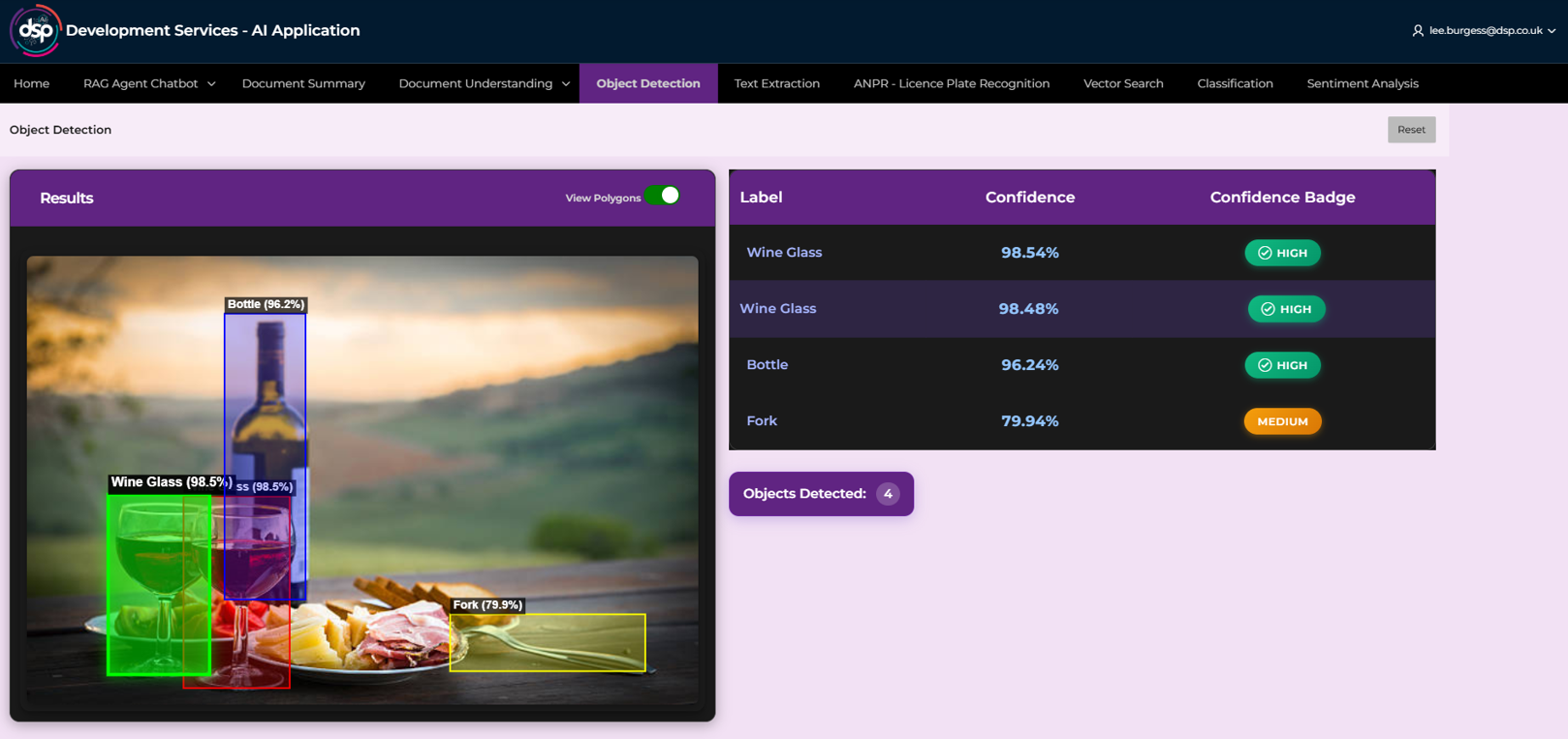
This utilises Oracle's Vision API, which provides pre-trained models capable of detecting and classifying a wide range of objects. The service processes images uploaded to OCI Object Storage and returns structured results that can be integrated into downstream business processes.
5. Text Extraction - OCR and Barcode Reading
The Problem:
Organisations deal with vast quantities of printed text, labels, barcodes, and signage that need to be digitised for processing. Whether it's reading product barcodes in a warehouse, extracting text from scanned forms, or capturing data from photographs, manual transcription is impractical at scale.
The Solution:
Upload an image to automatically extract all visible text using OCR (Optical Character Recognition) technology. The application identifies and extracts printed text, handwritten text, and barcodes from images, returning the content in a structured format ready for further processing.
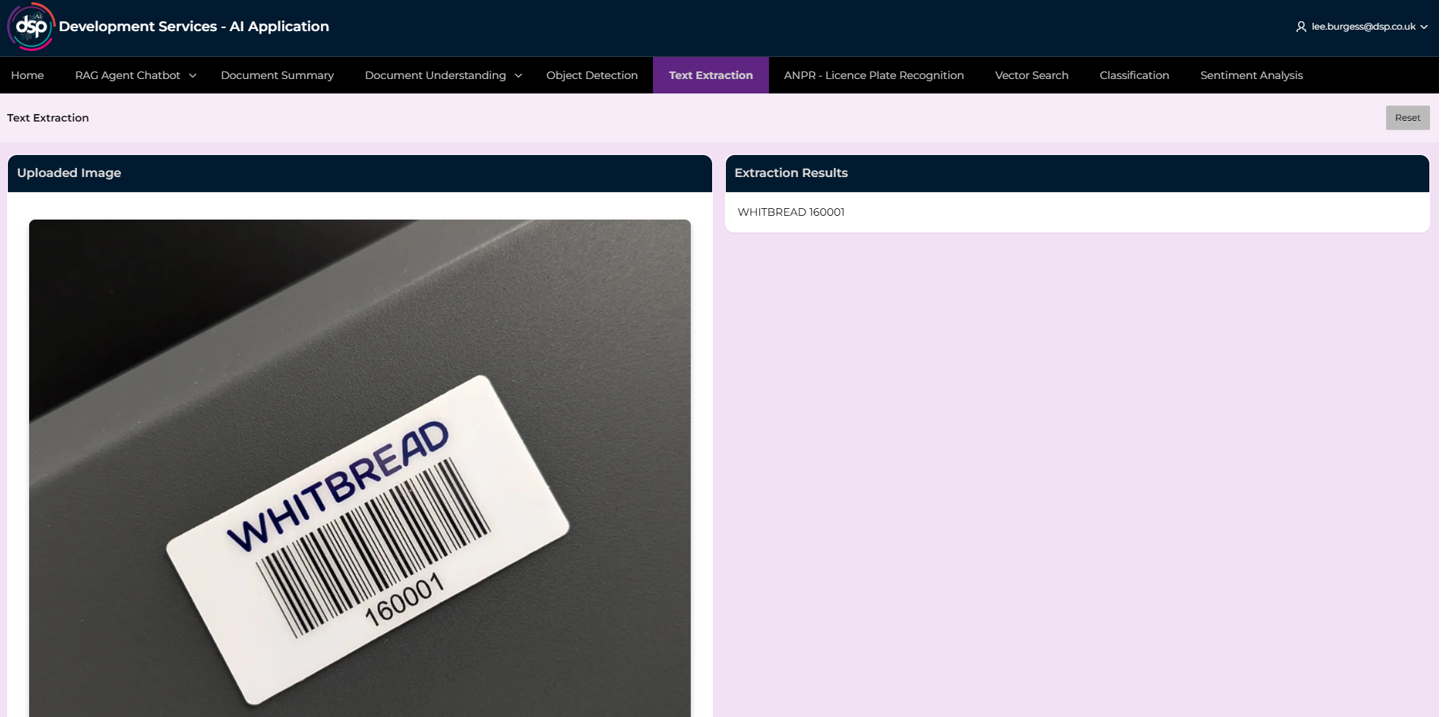
This utilises Oracle Cloud Infrastructure's Vision API for text detection and extraction. The service identifies text regions within images, extracts the content with high accuracy, and returns the results with positional data, enabling applications that need to understand not just what text is present, but where it appears.
6. ANPR - Automatic Number Plate Recognition
The Problem:
Automatic Number Plate Recognition is essential for car park management, law enforcement, toll collection, fleet tracking, and access control systems. Extracting registration plate data from vehicle images reliably and at speed is a prerequisite for any of these applications.
The Solution:
Upload an image of a vehicle to automatically extract the UK registration plate. The system identifies the licence plate region within the image, extracts the text, and applies pattern matching for recognised UK plate formats, including modern formats (two letters, two digits, three letters) and older formats.
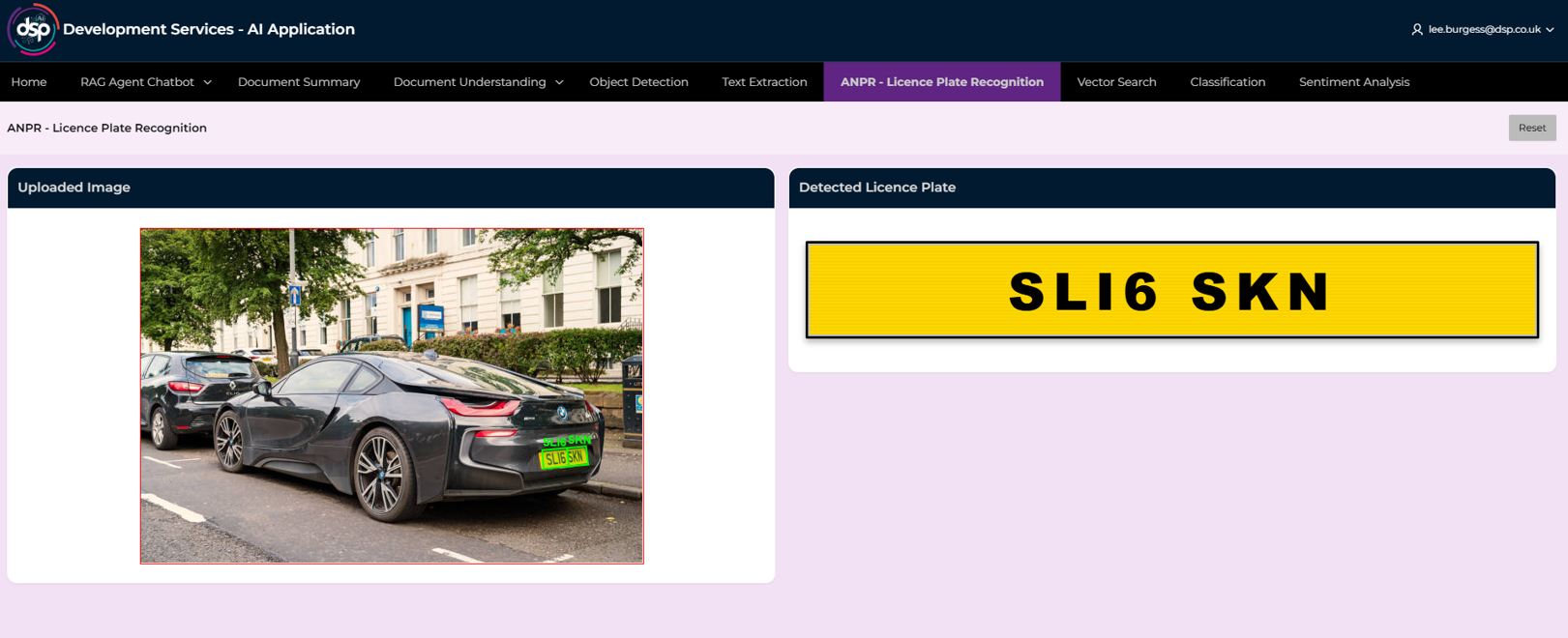
This utilises Oracle Cloud Infrastructure's Vision API and OCR for text detection and extraction, combined with a programmatic approach to identify and validate the licence plate data from the extracted text. This demonstrates how OCI's general-purpose AI services can be combined with domain-specific logic to solve targeted business problems.
7. Vector Search - Semantic Image Search
The Problem:
Traditional keyword-based search falls short when users need to find images based on what they contain or what they mean, rather than relying on manually assigned tags or filenames. As image libraries grow, organisations need smarter ways to search visual content.
The Solution:
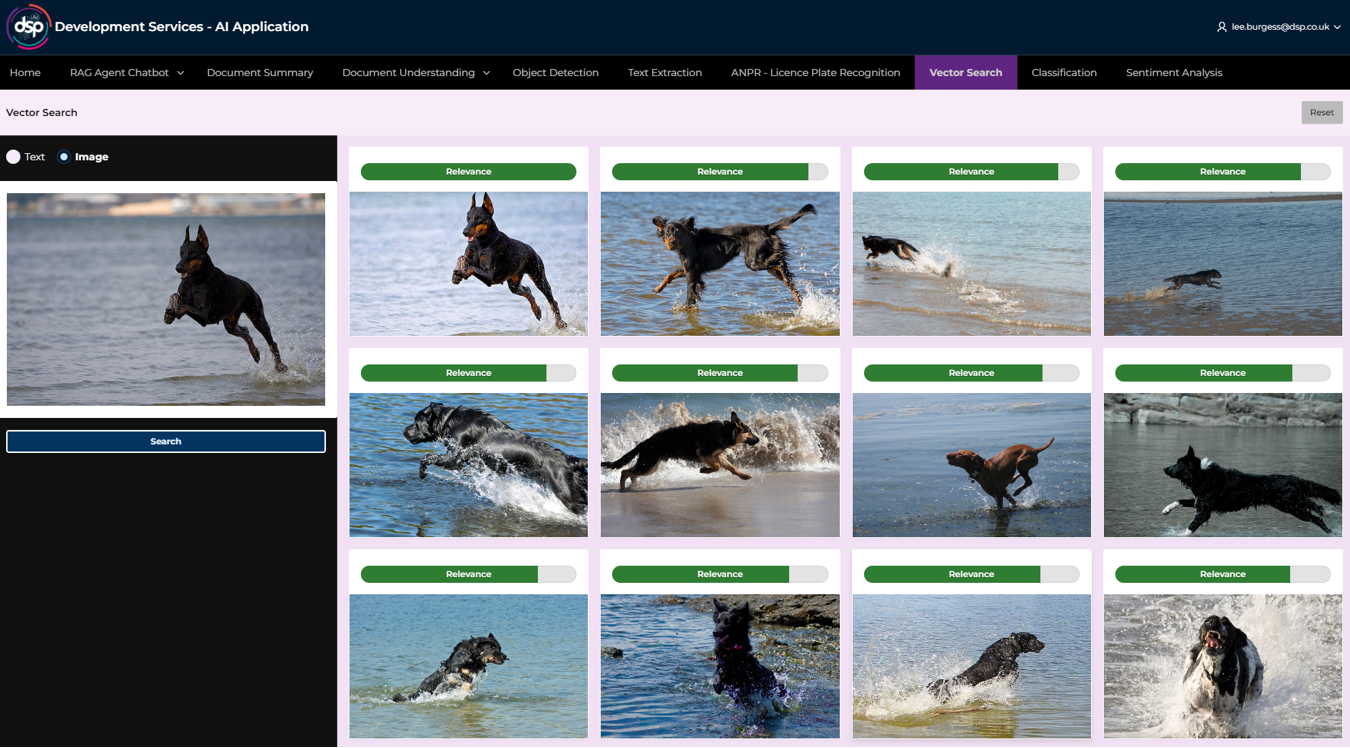
Search semantically for images using natural language queries. Rather than matching exact keywords, the system understands the meaning behind your search and returns visually and conceptually relevant results. This is powered by vector embeddings, mathematical representations of images and text that capture their semantic content.
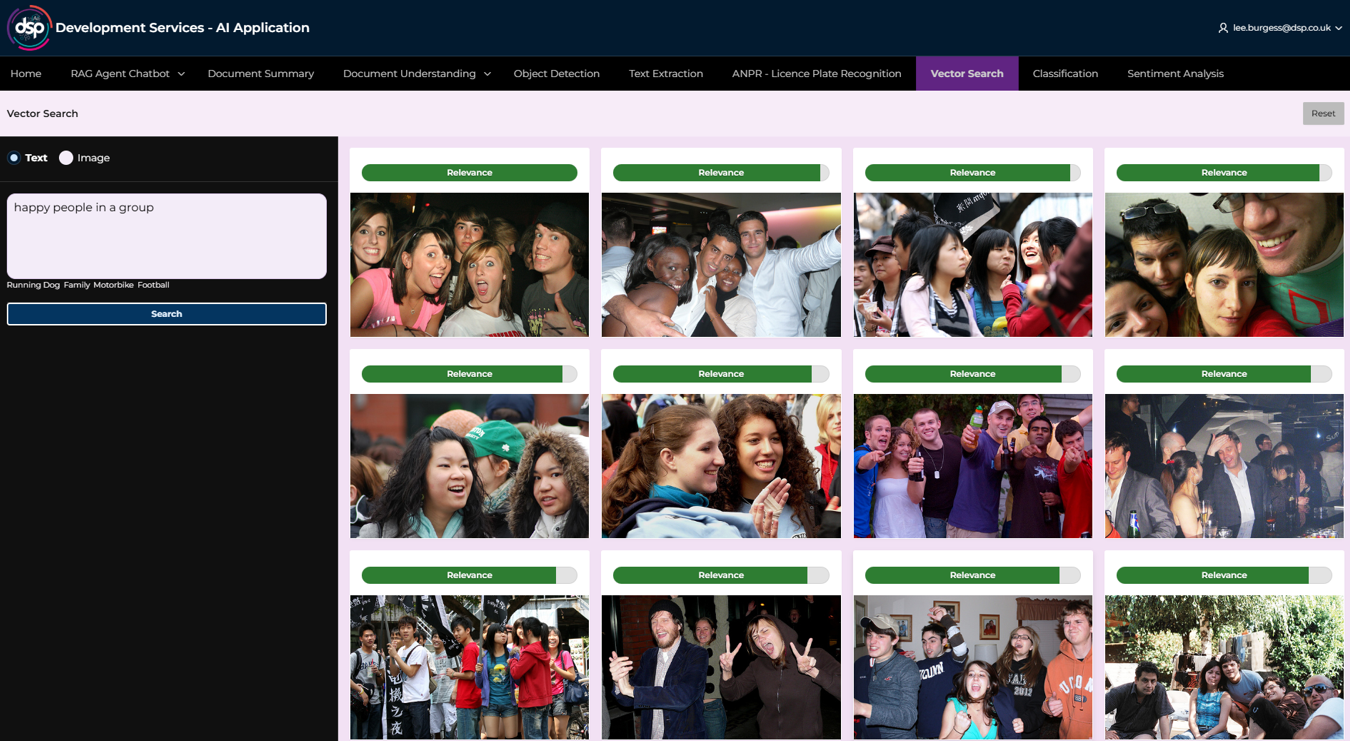
The application uses multimodal embeddings to convert both images and search queries into vectors, then performs similarity searches to find the closest matches. This enables powerful search experiences where a query like "happy people in a group" returns relevant images regardless of how they were originally labelled.
We can also use an image to search for similar images:
8. Classification - Email and Ticket Routing
The Problem:
Organisations receive high volumes of inbound communications, including emails, support tickets, and service requests, that need to be triaged and routed to the correct department. Manual classification is inconsistent, slow, and doesn't scale. Misrouted communications lead to delays and poor customer experience.
The Solution:
Classify emails, service tickets, or any other text to identify the department they should be routed to and the appropriate action to take. The system evaluates the content of each communication and returns a department classification along with reasoning and a confidence score.
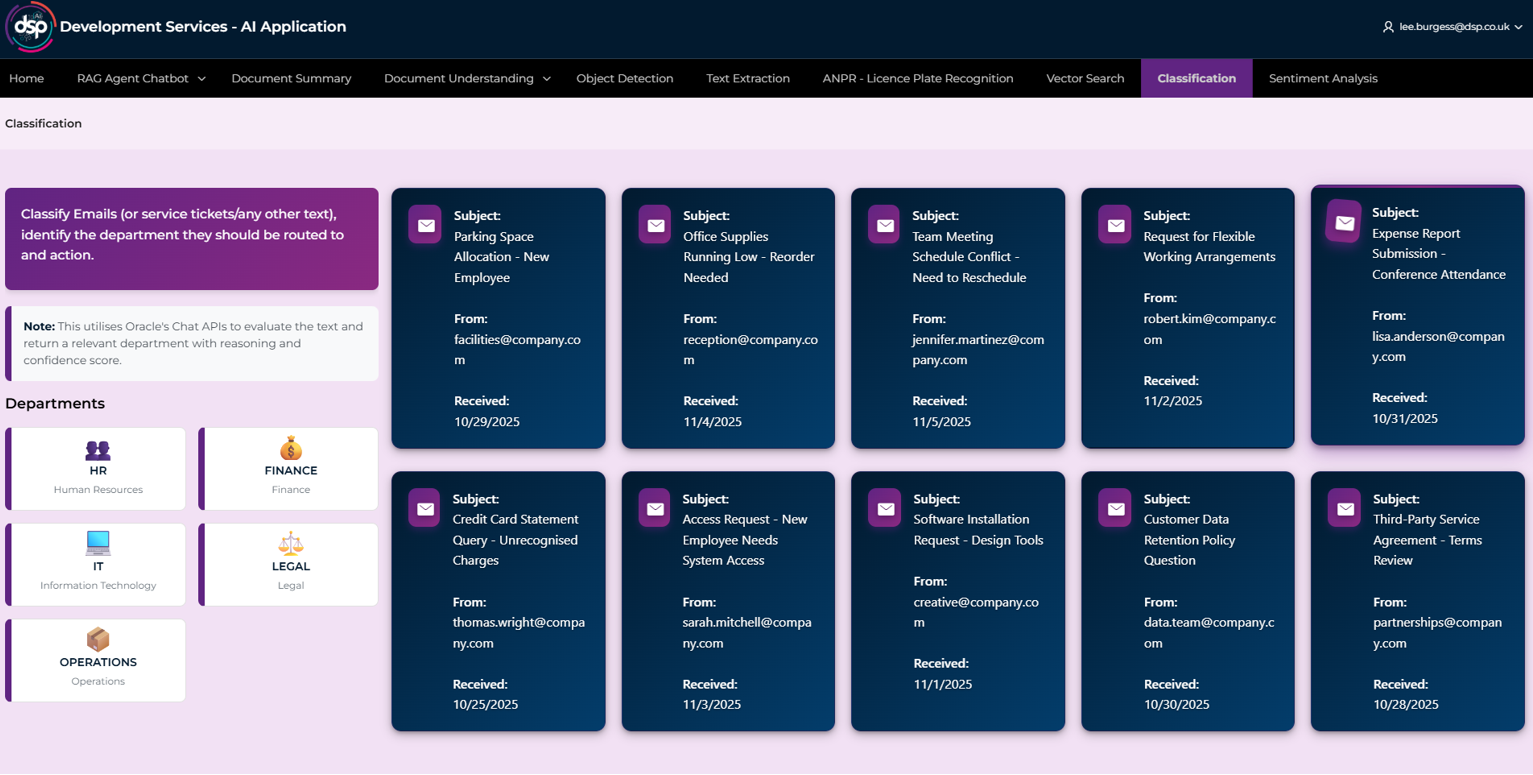
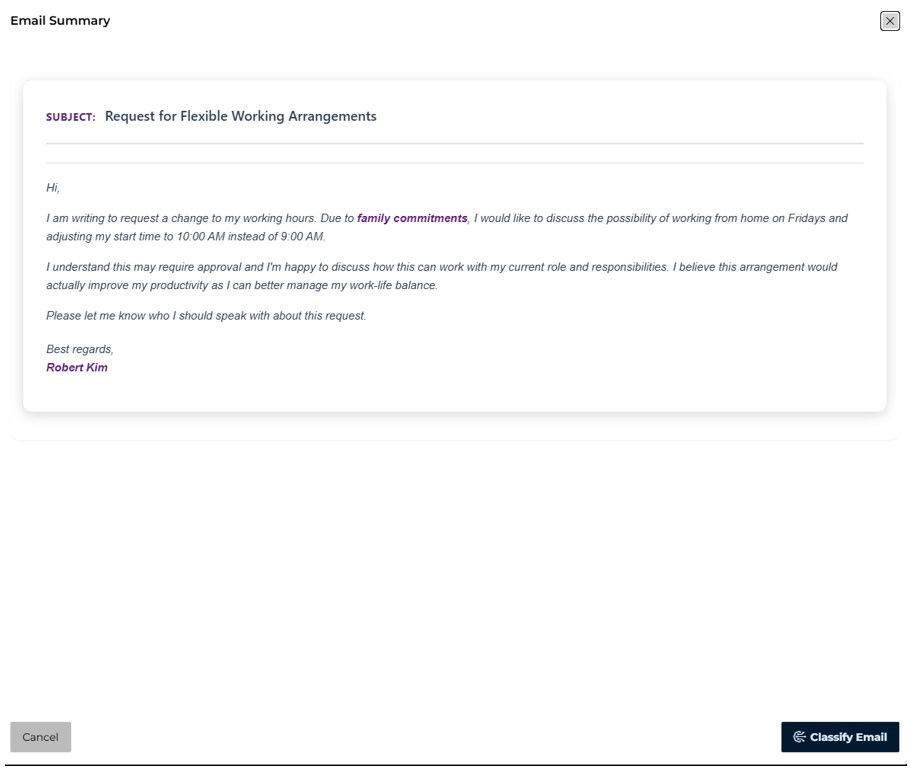
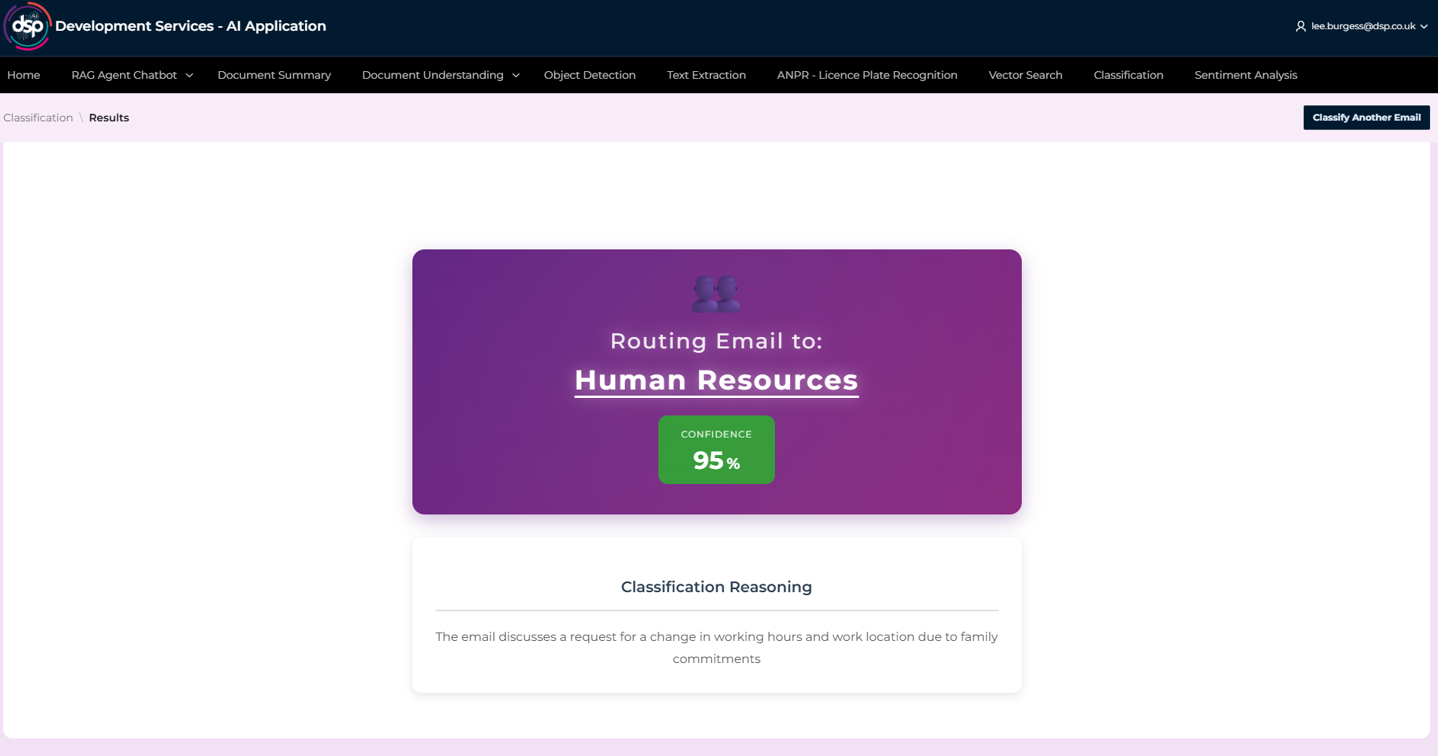
The supported departments include HR (Human Resources), Finance, IT (Information Technology), Legal, and Operations, though the model can be adapted to any organisational structure.
This utilises Oracle's Chat APIs to evaluate the text content and return a relevant department with clear reasoning and a confidence score, enabling automated or semi-automated routing workflows that dramatically reduce triage time.
9. Sentiment Analysis - Client Feedback Intelligence
The Problem:
Understanding how clients feel about your services is critical, but manually reading and categorising feedback at scale is impractical. Organisations need to quickly identify dissatisfied clients, recognise positive trends, and act on the insights hidden within unstructured feedback.
The Solution:
Analyse client feedback emails to determine sentiment and understand customer satisfaction. The system evaluates each piece of feedback and classifies it as positive (satisfied clients), negative (dissatisfied clients), or neutral (mixed feedback), along with detailed reasoning and a confidence score.
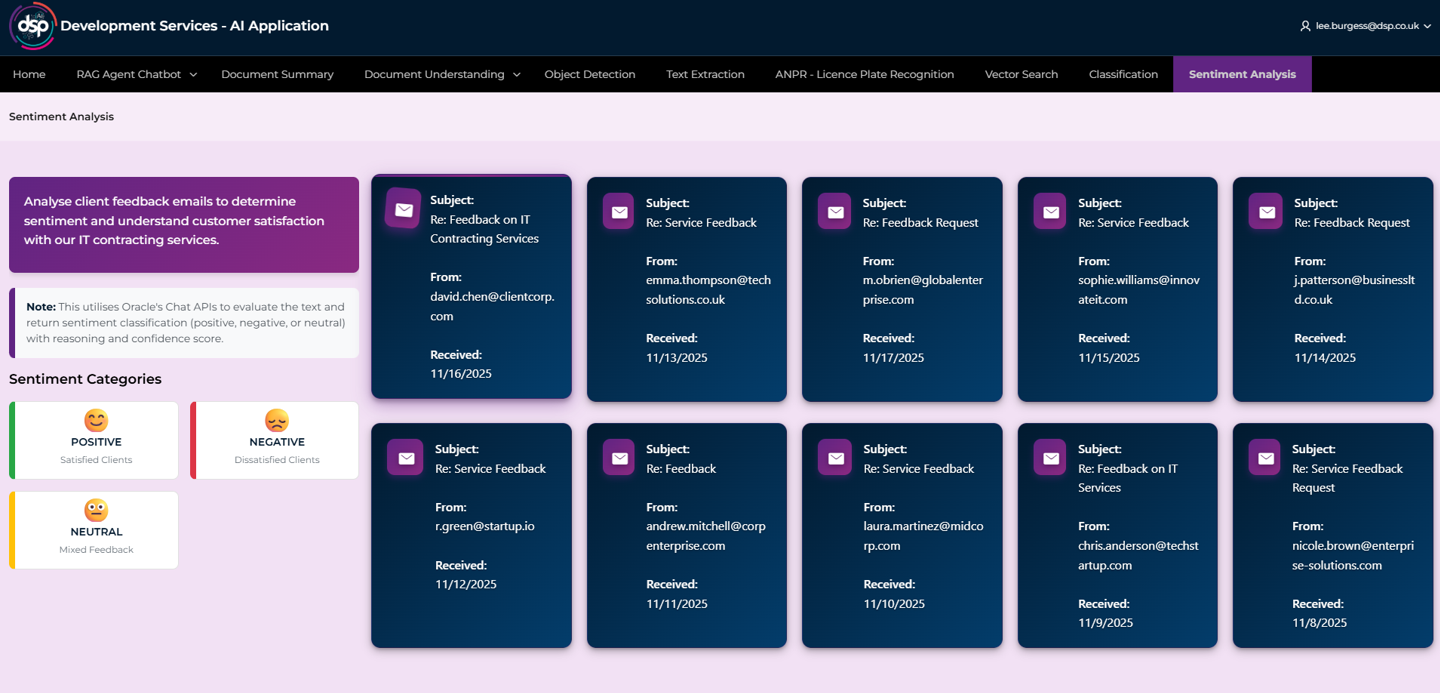
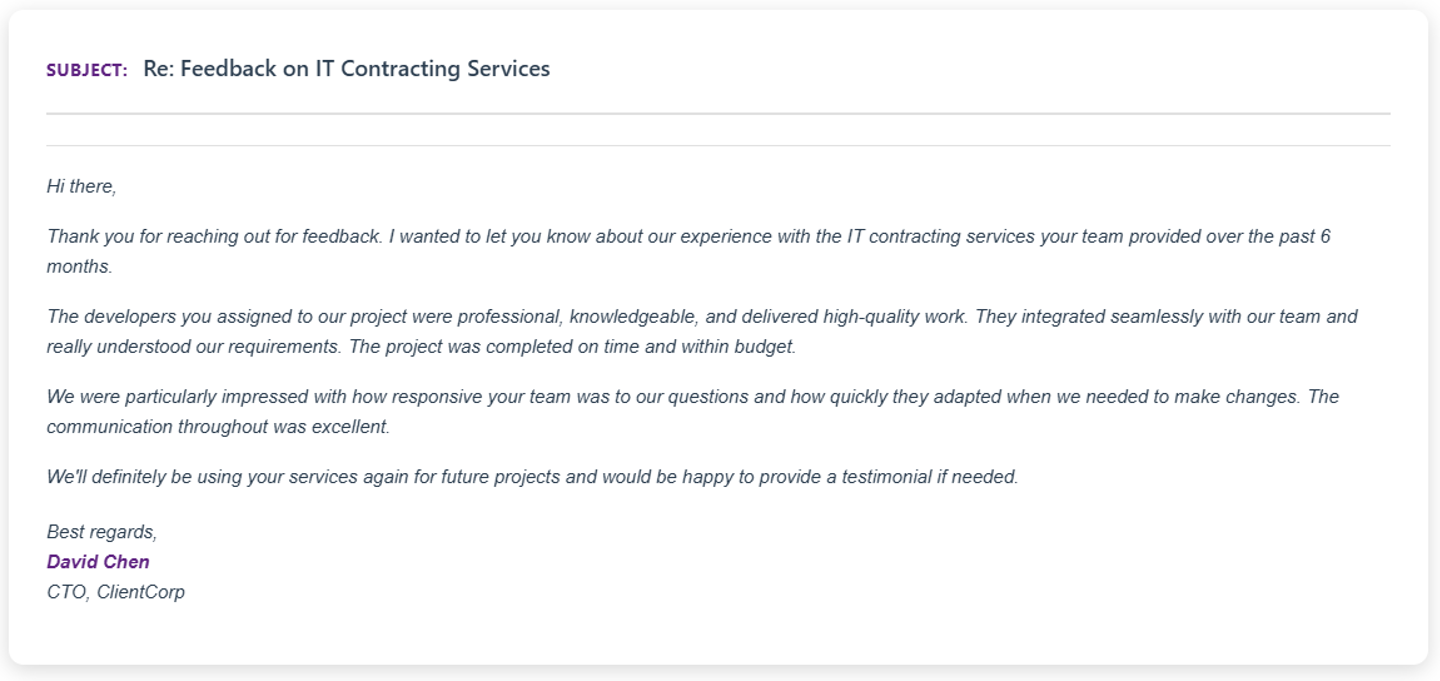
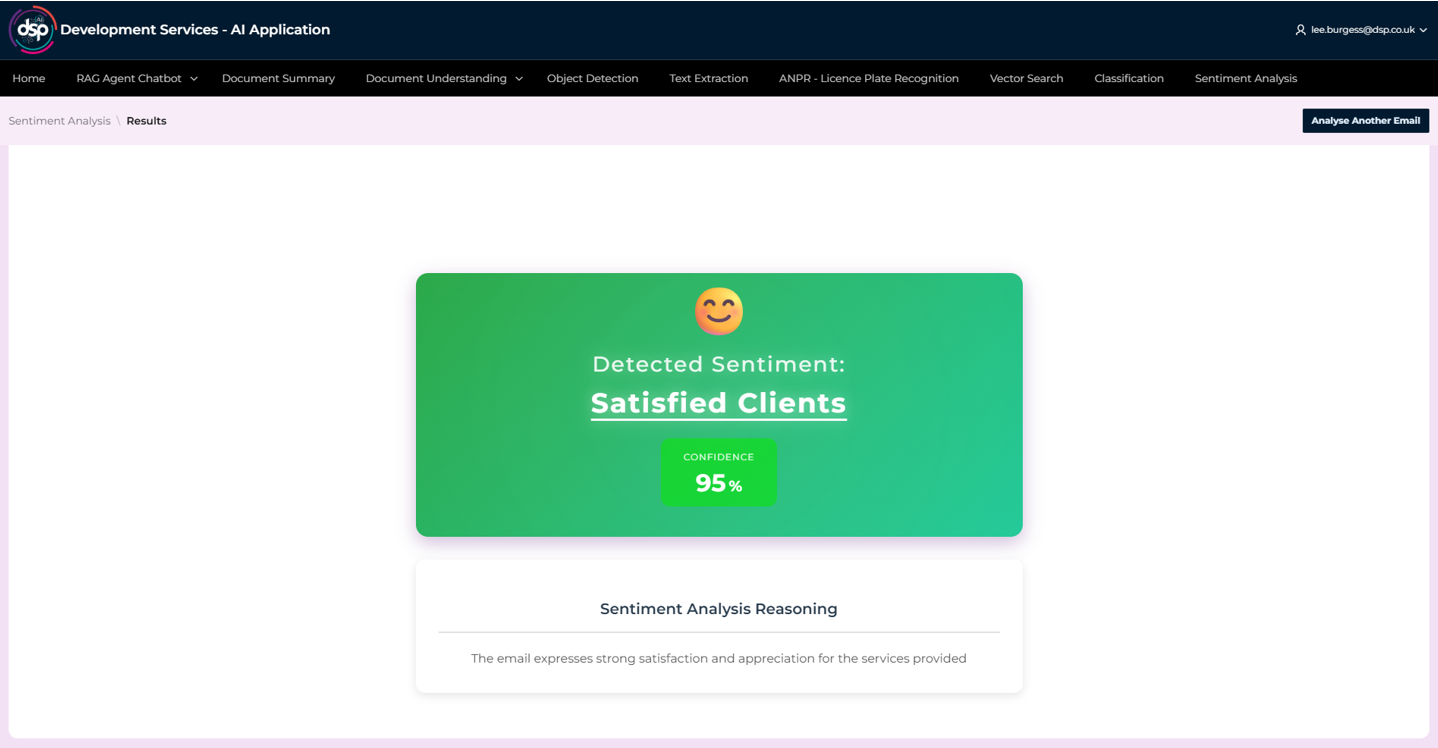
This utilises Oracle's Chat APIs to evaluate the text and return sentiment classification with reasoning and confidence scores. The structured output enables organisations to build dashboards, trigger alerts for negative feedback, and track sentiment trends over time - turning unstructured feedback into actionable intelligence.
Bringing It All Together
What makes this demo application compelling is not any single feature in isolation, but the breadth of what's achievable when Oracle's AI services are combined with the rapid development capabilities of Oracle APEX. Each of these nine use cases addresses a genuine business need, and each is built on production-ready OCI services that can scale with your organisation.
In this demo, we have used APEX primarily as a visual tool to show the input/output flow of each AI service and make the capabilities tangible for users. In the real world, APEX can play a much broader role: for many of these use cases, it can act as the orchestrator that kicks off AI-driven workflows. Think scheduled jobs that summarise incoming documents, approval processes that trigger sentiment analysis on feedback, or background processes that classify and route tickets without a user ever opening a screen. APEX is not only a front end for demos, but it can also be the engine that invokes OCI AI services, coordinates steps, and integrates results into your existing business logic and data.
The underlying architecture is straightforward: Oracle APEX provides the user interface and application logic, PL/SQL packages orchestrate the calls to OCI services, and OCI Object Storage handles file management. The AI services themselves, Generative AI Agents, Document Understanding, Vision API, and Chat APIs, are consumed via REST APIs, meaning there are no models to train or infrastructure to manage.
For organisations already invested in the Oracle ecosystem, this represents a powerful opportunity: deliver genuine AI-powered capabilities to end-users quickly, securely, and without the overhead of building and maintaining bespoke machine learning pipelines - whether those capabilities are exposed through interactive screens or run silently as automated workflows.
The future of enterprise applications is intelligent, and with Oracle AI services and APEX, that future is remarkably accessible.
If you want to talk to us about utilising any of these AI tools, contact us today, and one of our expert developers will be in touch.