

- Services

Getting to know us
- Industries
Recent case study:
Oracle EBS Cloud Deployment
Consolidating and Migrating assets into Oracle Cloud Infrastructure.

Most Visited Pages
-
- Resources
DSP-Explorer acquires leading Oracle Applications Managed Services Provider, Claremont, to further extend its data management capabilities.

Resources
- Contact us
Microsoft Fabric vs. Azure Synapse: Which Is Right for You?
Contents
Organisations building modern data platforms increasingly face a choice between two Microsoft analytics offerings: Azure Synapse Analytics and Microsoft Fabric. While they address overlapping use cases, they differ significantly in architecture, operating model, and the level of technical investment they require. Understanding these differences is essential to selecting the platform that best fits your organisation's data maturity and business goals.
What Is Azure Synapse Analytics?
Azure Synapse Analytics is a cloud-based analytics service that unifies data integration, enterprise data warehousing, and big data processing within a single collaborative workspace called ‘Synapse Studio’. It brings together tools such as Apache Spark, Azure Data Lake Storage (ADLS) Gen2 and Synapse SQL.
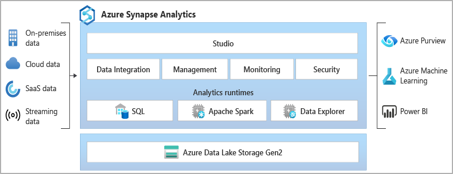 Figure 1. Azure Synapse Analytics Architecture and Ecosystem
Synapse follows a modular, Platform-as-a-Service (PaaS) architecture. Teams provision and configure individual components (i.e. compute clusters, SQL pools, storage accounts, etc.) and assemble them into a cohesive analytics environment. This gives organisations fine-grained control over infrastructure, making Synapse well-suited to environments with strict network isolation or compliance requirements.
What Is Microsoft Fabric?
Microsoft Fabric is an end-to-end, Software-as-a-Service (SaaS) analytics platform that consolidates data ingestion, warehousing, engineering, machine learning, and business intelligence into a single, centrally managed environment. It includes Data Factory, Spark-based processing engines (PySpark, Spark SQL), Fabric Data Warehouse, Lakehouse, Power BI, Data Science and OneLake storage.
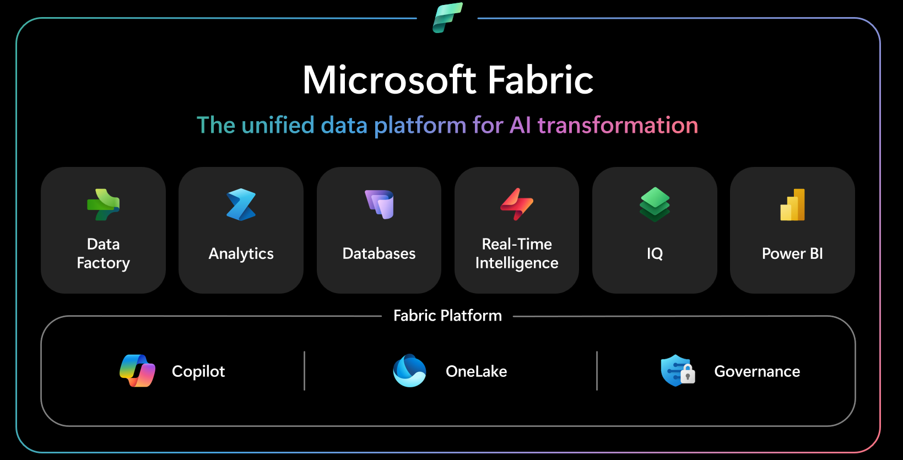 Figure 2. Microsoft Fabric: The Unified Analytics Platform
Fabric is designed to minimise infrastructure overhead. Compute and storage resources are provisioned automatically alongside each tool, removing the need for manual setup. At the core of Fabric's architecture is OneLake, a unified storage layer that eliminates data duplication by storing data once and making it accessible to every Fabric workload that needs it.
Comparing Azure Synapse Analytics and Microsoft Fabric
At a glance, the two platforms appear similar, but they diverge meaningfully once you examine their underlying architecture and operating model.
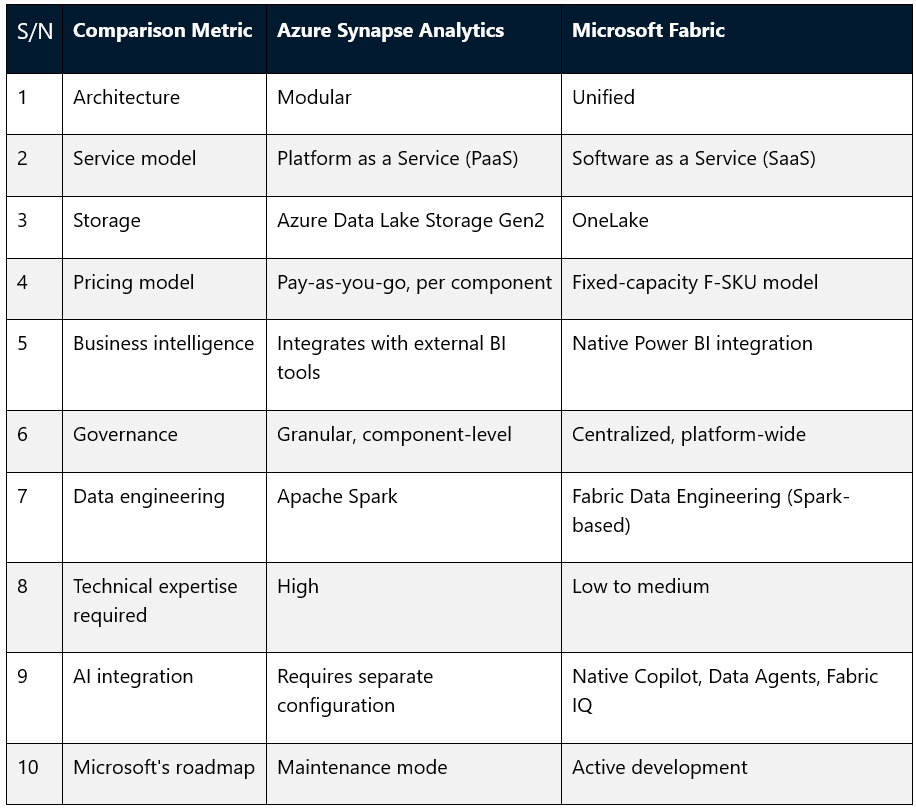
Which Platform Is Right for Your Organisation?
Microsoft currently supports both platforms, but its investment is clearly weighted toward Fabric. Synapse Analytics has entered maintenance mode, with Microsoft steering new feature development and customer migrations toward Fabric.
Azure Synapse Analytics remains the stronger choice when:
-
Workloads demand granular infrastructure control.
-
Advanced network isolation is required (managed VNets, private endpoints).
-
Existing pipelines depend on legacy T-SQL features not yet supported in Fabric.
-
Your team has the technical expertise to manage and optimise a modular architecture.
Microsoft Fabric is generally the better fit when:
-
Power BI is your organisation's primary BI tool. Fabric's Direct Lake mode enables near-real-time semantic model refreshes without the overhead of traditional import or DirectQuery modes.
-
You want to reduce storage costs and data duplication through OneLake's single-copy architecture.
-
Your team prefers a lower-maintenance, low-code path to enterprise analytics.
-
You want early access to Microsoft's latest AI-driven capabilities, including Copilot and Fabric Data Agents.
It's worth noting that several of Fabric's newer capabilities, particularly around AI and governance, are still in preview and may evolve before reaching general availability. Organisations evaluating Fabric for mission-critical workloads should account for this when planning a migration timeline.
Conclusion
There is no universally "better" platform; there’s only the right platform for your organisation's current needs and data maturity. Azure Synapse Analytics offers deep infrastructure control for technically sophisticated teams, while Microsoft Fabric offers a streamlined, low-overhead path to enterprise-grade analytics. Given Microsoft's roadmap, organisations currently on Synapse should begin evaluating Fabric migration paths as part of their long-term data strategy.
Contact us to speak with our data analytics engineers about which platform and migration path is right for your business.